💬
Live Chat
Free Legal Consultation
×
Protect your brand online in just minutes with Trademark USP. Starting at $49 + applicable fees.
4.8

Choose the package that best suits your needs and let our experienced legal team guide you through the trademark registration process with professionalism and care.
I only need what it takes to file
+ applicable fees
Includes:
I want an enhanced and thorough process
+ applicable fees
Includes basic package, plus:
I want premium legal support for best success
+ applicable fees
Includes standard package, plus:
Don't just take our word for it
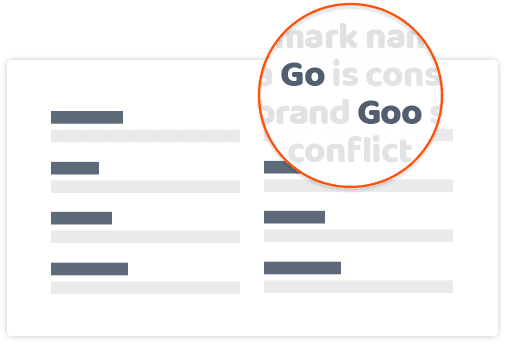
Most of the brands, logos and slogans you love, know and trust have been registered. A registered mark gives you a presumption of ownership and a presumed right to use the brand nationwide giving you broader protection in courts. Once registered, present yourself as an established and serious business with the ® symbol after your name, logo or slogan. Other benefits include:
Before spending your time and money filing an application, you should do a search to see if your mark is already in use or registered by someone else. A search will help avoid obvious duplications of pre-existing marks. If the USPTO rejects your application, the fees to Trademark USP and the USPTO are not refundable. If your company is just beginning, it’s better to make name changes now rather than invest in building a brand only to learn that you have to change the name and lose all of your goodwill.
All packages include a free, federal direct-hit search. We also offer more comprehensive searches that will include wider searches on the federal, state, common law, and global levels. Enjoy a better peace of mind while your trademark application is pending with the USPTO.

See why others are choosing Trademark USP!

I used the Standard Package and felt completely secure. The 15-minute counsel session cleared up all my questions about brand exclusivity, and the team’s quick filing meant my application got to the USPTO fast. The included Cease and Desist letter is huge peace of mind for 2025. They delivered outstanding value and attorney oversight without the high firm price.
via Trustpilot1

My product spanned two tricky trademark classes, and I was worried about a rejection. Trademark USP’s legal expert flawlessly handled the classification and description. The whole federal registration process was seamless and the platform is incredibly easy to use. I recommend this service to any serious business owner prioritizing accuracy and efficiency.
via Trustpilot2

The Premium Package Rush Processing was absolutely essential for my product launch. Getting my application reviewed and submitted within 48 hours made a massive difference in securing my date. Plus, the 1-hour strategic guidance was invaluable. Trademark USP offers the gold standard for quick and confident IP filing in 2025.
via Google Reviews3

I filed my trademark application through Trademark USP and immediately signed up for the Monitoring & Maintenance service. Getting alerts on potential infringement gives me so much confidence. Their team truly simplifies the entire lifecycle of trademark protection, from initial filing to ongoing defense. A must-have tool for any modern brand!
via Google Reviews4
Still have questions? Call+1 (650) 384-0370 or LIVE CHAT with us for real-time support.
One way to understand a trademark is that it is a word, phrase, symbol, and/or design that identifies and distinguishes the source of the goods of one party from those of another party. A “service” mark distinguishes the source of a service, rather than a good, but the two are typically simply referred to as a “trademark” or “mark”. In more general terms, getting a trademark protects a brand. Many of the well-known brands, logos and slogans you love, know and trust have been registered with the United States Patent and Trademark Office. Generally, the registration of a trademark entitles the registrant to a presumption of ownership of the brand on a national level and a presumed right to use the brand nationwide. It may help prevent someone from registering a confusingly similar mark later and may also help the registrant bring a case in federal court if someone infringes on the brand. Once registered, a registrant can typically start using the ® symbol after the name, logo or slogan. After a mark is properly registered and used for a five-year period, Trademark USP can also help file a “Declaration of Incontestability.” Considered by some the greatest protection under U.S. trademark law, this may help prevent others from contesting a trademark on the following grounds: (1) the mark is not inherently distinctive; (2) it is confusingly similar to another mark that someone else began using first; or (3) the mark is simply functional as opposed to identifying the source of the goods or services. Please also read WHAT YOU MUST KNOW BEFORE USING THIS WEBSITE.
Under U.S. law, a “common law trademark” is generally established when someone uses a company name, logo or slogan in commerce, even if it is not registered. So, why pay to register a trademark when a common law trademark may already exist? Common law rights ordinarily are limited to the geographic area where the mark is used as opposed to the nationwide protection customarily obtained when a mark is registered with the USPTO. So, unless registered, the use of a mark can be geographically limited, which hampers the ability to expand the brand. On the other hand, a person using a mark in a limited geographic area could be boxed in by someone else who offensively registers a similar mark. In addition, registration of a trademark can give the person holding the registered trademark a leg up in court as to the validity of the mark and the date of usage in later trademark infringement litigation, if it comes to that. There are also favorable remedies available to registered trademark owners in the event of litigation. Finally, once a trademark is accepted by the USPTO, it will be maintained in the USPTO database, which can discourage others from using the mark in the future. Future companies should be on notice that the mark is already spoken for, which should in turn help avoid at least some disputes..
There may be advantages to registering both a name and an associated logo. But bear in mind, each filing requires its own application, government filing fees and processing fees to Swyft Legal. Even if you were to apply on your own, it would cost at least $700.
A more budget-friendly option could involve registering just the name trademark. Wrongful use of names seems to be more common than wrongful use of logos. Trademarking a name generally provides broader protection because it prevents any use of the name that causes confusion, even if someone tries to use the name within a unique logo.
A mark for a logo typically protects the shape, orientation, stylization and sometimes color in that particular logo. Registering ordinarily prevents others from using that logo or something confusingly similar to the logo. Even if a company name is in the logo, registering the logo may only protect the use of that name in the particular way it is used in the logo and not the use of the name more generally. Moreover, amended or redesigned logos usually require a new application for the new logo. As may be expected, logo changes seem to be more common than name changes.
Much like how the availability of a corporate name in a given state does not necessarily provide superior trademark rights to use the name in commerce, the availability of the domain name is not an an indication either. A company could have a trademark name on a product or service, but not have acquired the domain name.
The availability of the domain name should be one part of a comprehensive search, which Trademark USP offers, to help evaluate the strength of a brand name or slogan and the likelihood of a trademark being approved. Using a domain name as part of a brand that sells goods or services may establish common law trademark rights. A “common law” trademark can be established when a name, logo or slogan is used in commerce, even if it is not registered. Common law rights, however, are limited to the geographic area where the mark is actually used as opposed to the nationwide protection typically established by registration of a mark with the USPTO.
The geographic limitations of an unregistered mark can make it difficult to expand a business. On the other hand, a person using a mark in a limited geographic area could be boxed in by someone else who offensively registers a similar mark. In addition, registration of a trademark customarily gives the person holding the registered trademark a leg up in court as to the validity of the mark and the date of usage in later trademark infringement litigation, if it comes to that. There are also favorable remedies available to registered trademark owners in the event of litigation. Finally, once a trademark is accepted by the USPTO, it should be maintained in the USPTO database, which can discourage others from using the mark in the future. Future companies should be on notice that the mark is already spoken for, which should in turn help avoid at least some disputes.
General benefits to registering a mark:
If investing heavily in a marketing campaign with a slogan, a company might consider registering that slogan in connection with the goods or services they offer well.
Like all trademarks, a slogan you wish to register should be inherently distinctive and creative or have developed a secondary meaning. In other words, “really good pizza” probably can’t be trademarked unless that saying has become so famous that most consumers associate it with a certain pizza brand.
Initiating the process will usually take anywhere from 5 to 10 minutes on the Trademark USP website. For a typical application, be prepared to provide at least the following:
Thousands have protected their brand by filing a trademark.
Register my trademark